

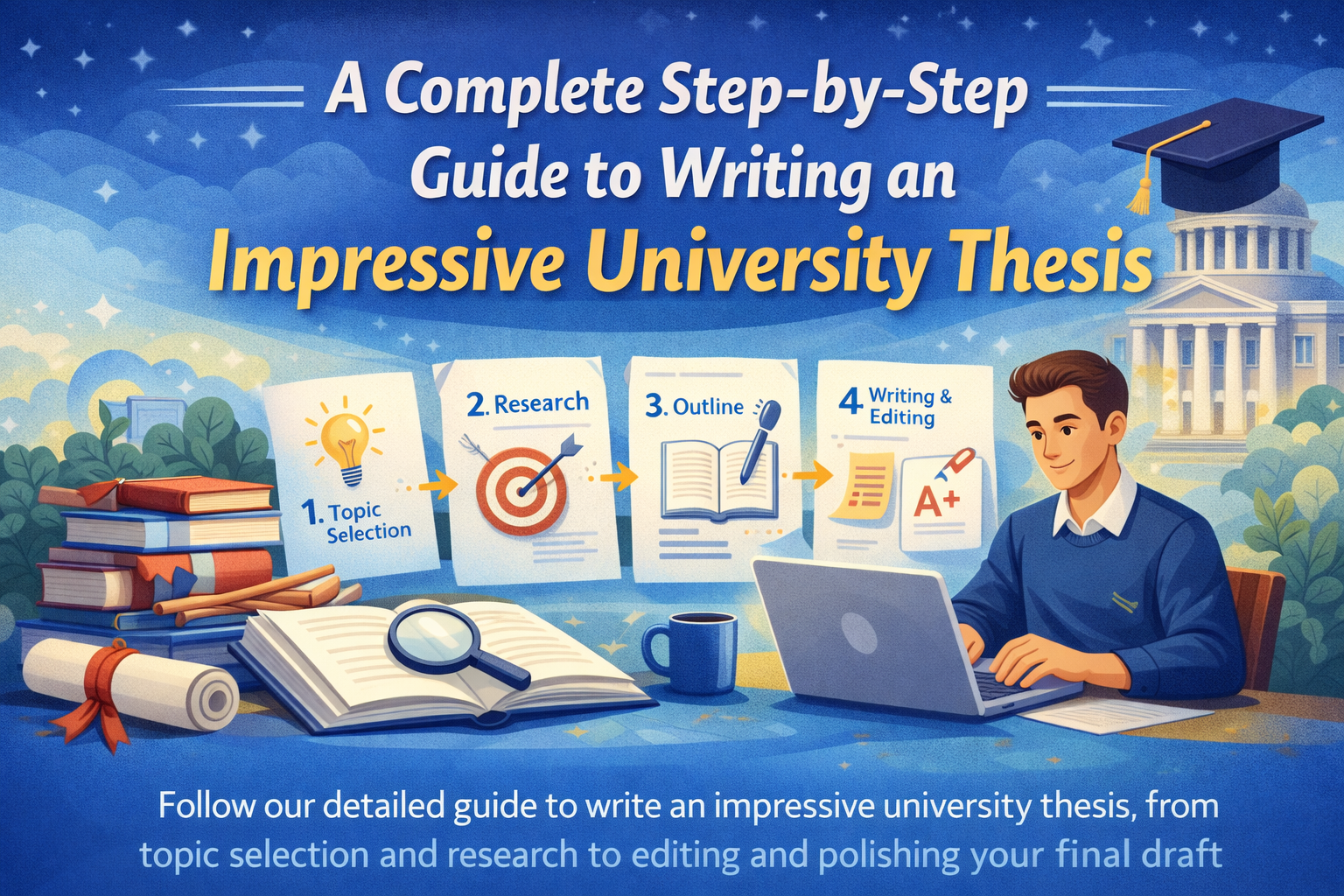
University writing thesis is a daunting task, and it is also one of the most important academic tasks you will succeed in during your higher education life. To write a high-quality thesis, you need not only an in-depth knowledge of the topic you are working on, but also to be able to organise your thoughts, research, and writing in an effective way. This guide will divide each part of the thesis writing process into separate components and provide you with a set of tips and suggestions to develop a strong and properly organised final work.
1. Understand the Purpose of Your Thesis
The initial task when it comes to writing an impressive thesis at the university is to get clear about the purpose of the thesis. A thesis should demonstrate your skill in doing a deep research and providing a clear with well constructed analysis of a specific topic. You can play your role in scholarly discussions, prove your competencies, and provide new knowledge.
You should also start by reading the instructions of your department or university as a whole before you start writing. These will give you details on how to format, deadlines, and any other particularities that you have to follow.
2. Choose a Research Topic that Interests You
It is important to choose an interesting and topical topic for your thesis. As much as you should love your topic of discussion, it must be a specific topic capable of enabling you to carry out thorough research.
In the event that you cannot develop ideas, you can think of going to academic journals, books, or you can even go and talk to the professors to get some inspiration. A thesis should be dedicated to a special research question that can assist you immerse yourself in it and contribute to the sphere. Once you have settled on a topic, it is a pleasant thought to narrow it down even further so that you can manage it within the context of your thesis.
3. Conduct Thorough Research
Any good thesis is done through thorough research. You will have to assemble diversified academic materials, such as books, journal articles, online databases, and other academic publications. Make use of trusted academic libraries and sources as a way of ensuring that the information you obtain is credible.
Note down everything that you research in detail, and arrange your data in terms of themes or topics that will be used to develop your thesis. Do not forget that your research will also guide your thesis and assist you in creating a powerful argument.
In case you are struggling to handle your research or you are not sure how to arrange the research findings, you may want to seek the help of a thesis service. Such services will be useful in assisting you in the process of researching and writing your thesis so that your thesis will have a sound academic foundation.
4. Create an Outline for Your Thesis
You should have an elaborate outline of your thesis before you begin writing. This will assist you in structuring your ideas and also making sure that your arguments make sense.
The standard content of the thesis is:
- Introduction: A description of the topic, research questions, and objectives.
- Literature Review: Overview and discussion of previous studies on your subject.
- Methodology: How are you going to do your research?
- Results and Discussion: The collection of the data you have collected and discussing it.
- Conclusion: Overview your findings and give some recommendations on where research could go in the future.
Developing an outline will not only simplify the process of writing but will also provide you with a well-defined road map to take you on your way, ensuring that you do not go astray.
5. Start Writing Your Thesis
Having a good outline now, you are ready to begin writing your thesis. Start with the parts that you are comfortable with, and it may be the methodology, literature review, or even the conclusion.
Be careful with every part and ensure that you outline your arguments clearly and logically. Cite correctly and make sure that all your arguments are backed by the results of your work. In case you realise you are not able to write or you require the help of a professional. By hiring a dissertation ghostwriter, one can save time and energy required to compile a well-structured and articulated thesis.
6. Edit and Revise Your Thesis
When you have the first draft of your thesis, the second step is revision. Success in your thesis depends on editing. Here you polish your points, clear up any misunderstandings, and get yourself out of grammatical or formatting mistakes. Before revising, it can be useful to take a break so that you can look at your work with new eyes. Professors, peers, or professional thesis writers are also the people you can consult to get their feedback on whether your thesis is at its best.
7. Final Review and Submission
After finalising your thesis, make sure to proofread it once again before you submit it. Check formatting rules, make sure that your citations are in order, and that your thesis is structured as it was in your first plan. Make sure that your thesis has clearly answered your research question and that your conclusion is consistent with what you have shown.
Conclusion
Composing a great university thesis can be a challenging process, yet, with a certain plan of action, good research, and the assistance of the help desk, the writing of a thesis that would be both memorable and favored can be accomplished. No matter whether you seek the help of a thesis writing services or pay a dissertation ghostwriter to help you with your writing, you should bear in mind that the secret of success lies in hard pre-writing, writing, and finally revision.